
Keep It Simple: My One-Trip System for a Day of Florida Diving
One of the lessons I’ve learned from years of diving is that you don’t need to bring everything you own on every dive.
For a typical recreational day of boat diving here in Florida, my goal is pretty simple: bring everything I actually need, keep it organized, protect the important equipment, and be able to carry it all to the boat in one trip.
Over time, I’ve settled on a simple three-piece system.
1. The Dive Crate
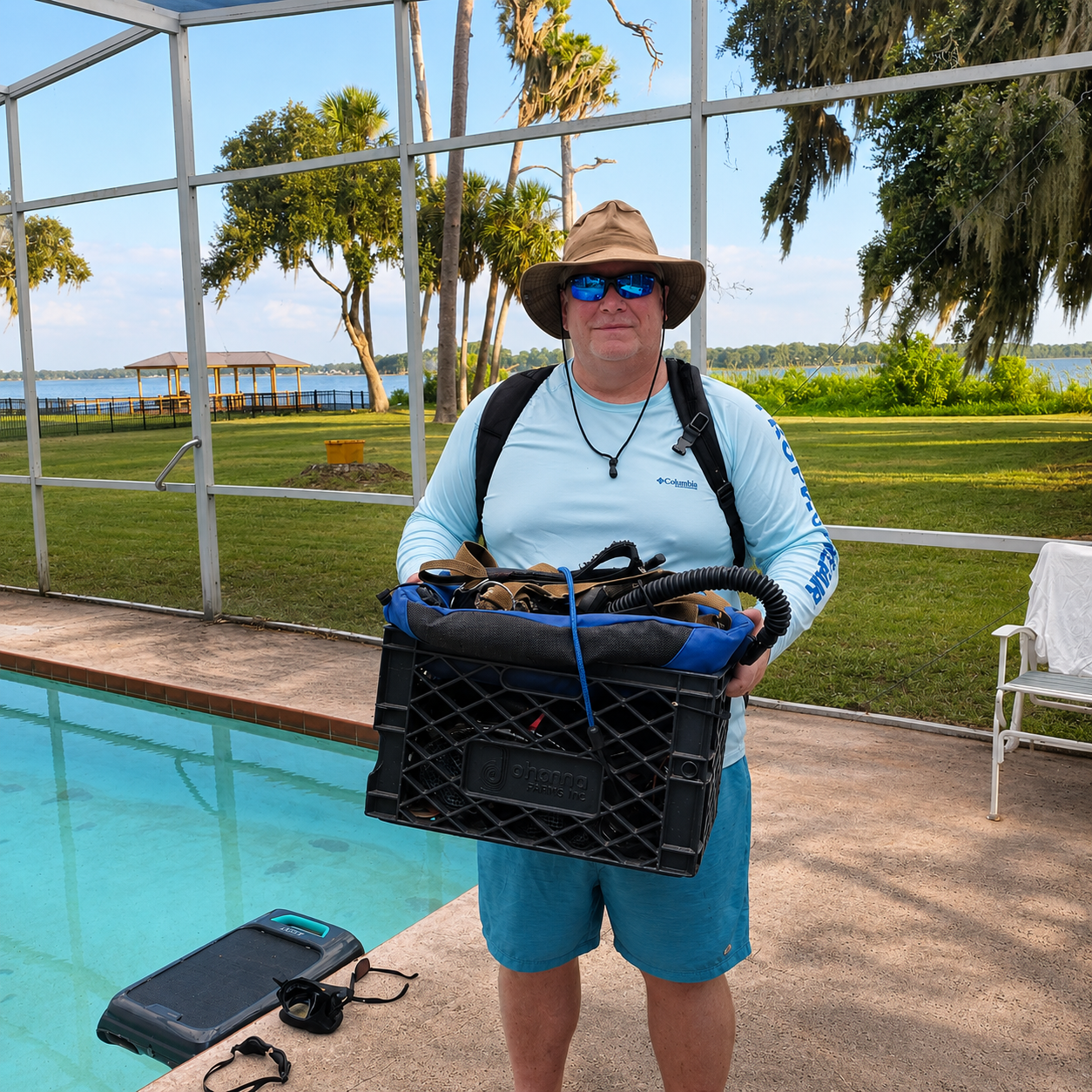
Instead of a traditional scuba gear bag, I use a heavy-duty plastic crate for most of my actual dive equipment.
My BC sits across the top and is secured with bungee. Inside are my regulators, dive computer and other essential equipment.
Across one end of the crate, I’ve run 1/4-inch shock cord through the openings. This creates an incredibly simple accessory rack. Reels, spools, lights and other equipment equipped with bolt snaps can hang from the bungee instead of disappearing into the bottom of a gear bag.
I’m considering adding a second bungee rail to give the smaller accessories a little more room.
The crate has several advantages. It drains immediately, I can see my equipment, it’s easy to rinse, and there’s no zipper to corrode or break.
Most importantly, I haven’t filled every available inch.
There’s still enough room to add another regulator or two when I’m diving doubles. I want the system to remain flexible rather than building permanent compartments that dictate what I can carry.
2. The Wet-Gear Backpack
My second piece is a simple mesh backpack.
This carries the bulky stuff:
- 3mm wetsuit
- Lavacore hooded vest
- Booties
- Fins
- Mask
The beauty of mesh is that I don’t care if anything is wet. After the dive, everything goes right back into the backpack.
Put the backpack on, pick up the crate, and I’m headed for the boat.
For most recreational boat dives, my tanks and weights are already aboard, so there’s very little else to carry.
3. The Dry Bag
The third piece is for everything that shouldn’t get soaked.
I keep this minimalist as well.
A small microfiber towel, logbook and pen, sunscreen, sunglasses, hat, water, a snack, phone and keys are generally enough. Of course I have my wallet with ID, c-cards and we can’t forget the tip for the crew!
I’m also adding a very lightweight packable rain shell. On a Florida dive boat, a rain jacket isn’t just for rain. A waterproof shell also makes an excellent wind and spray barrier after a dive.
That may allow me to eliminate the separate windbreaker I currently carry.
A dry T-shirt is another small luxury that doesn’t take much room but can feel pretty good after a couple of dives.
The Save-a-Dive Kit
I’m also putting together a small tool roll specifically as a Save-a-Dive Kit.
There’s an important distinction here.
I’m not trying to bring a regulator repair bench onto the boat. The purpose is to solve the little problems that can unnecessarily end a day of diving.
A couple of small wrenches, Allen keys, screwdrivers, pliers, cutters, an O-ring pick and valve-core tool will handle most field jobs.
The spares may actually be more important than the tools.
Tank and regulator O-rings, HP spool and O-rings, LP and HP hose O-rings, port plugs, mouthpiece and zip ties, inflator valve core, some cave line, shock cord and assorted zip ties take almost no room.
I’d also include a spare LP inflator hose.
The philosophy is simple:
The tool roll fixes the little problem.
A spare regulator fixes the big problem.
If something requires substantially more work than that, it probably shouldn’t be repaired on the deck of a dive boat anyway.
Organization Is Part of Dive Preparation
There’s another reason I like this system.
Organization makes it easier to recognize when something is missing.
Instead of throwing everything into one enormous scuba bag, every piece of equipment has a general location.
Crate: life-support equipment and accessories.
Mesh backpack: exposure protection, mask and fins. 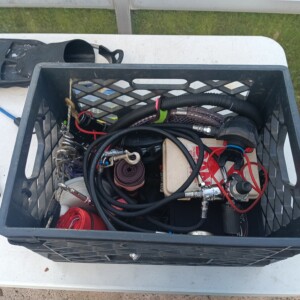
Dry bag: personal items that need to stay dry.
Before leaving home, a quick look at those three pieces tells me a lot.
When the diving is over, the system works in reverse. Wet equipment goes into containers designed to handle wet equipment. Dry things stay dry. Nothing requires elaborate repacking at the dock.
I may need to make a second trip for my tanks, as I like my steels, weights are typically available on the boat, be sure to double check that. Often boats can have rental tanks available making things quite convenient.
Don’t Pack for Every Dive You’ve Ever Made
It’s tempting, particularly as we accumulate equipment over the years, to prepare for every conceivable situation.
That’s how a simple two-tank recreational dive turns into an expedition.
Instead, I try to pack for the dives I’m actually making that day.
Technical dive? The system expands.
Doubles? Add the appropriate regulators.
Different exposure protection? Change what’s in the mesh bag.
But for an ordinary Florida recreational boat dive, I want things simple.
One crate. One mesh backpack. One small dry bag.
Everything has a purpose. Everything has a place.
And ideally, I can get from the truck to the boat in one trip.
Sometimes good dive preparation isn’t about bringing more gear.
It’s about knowing what you don’t need to bring.